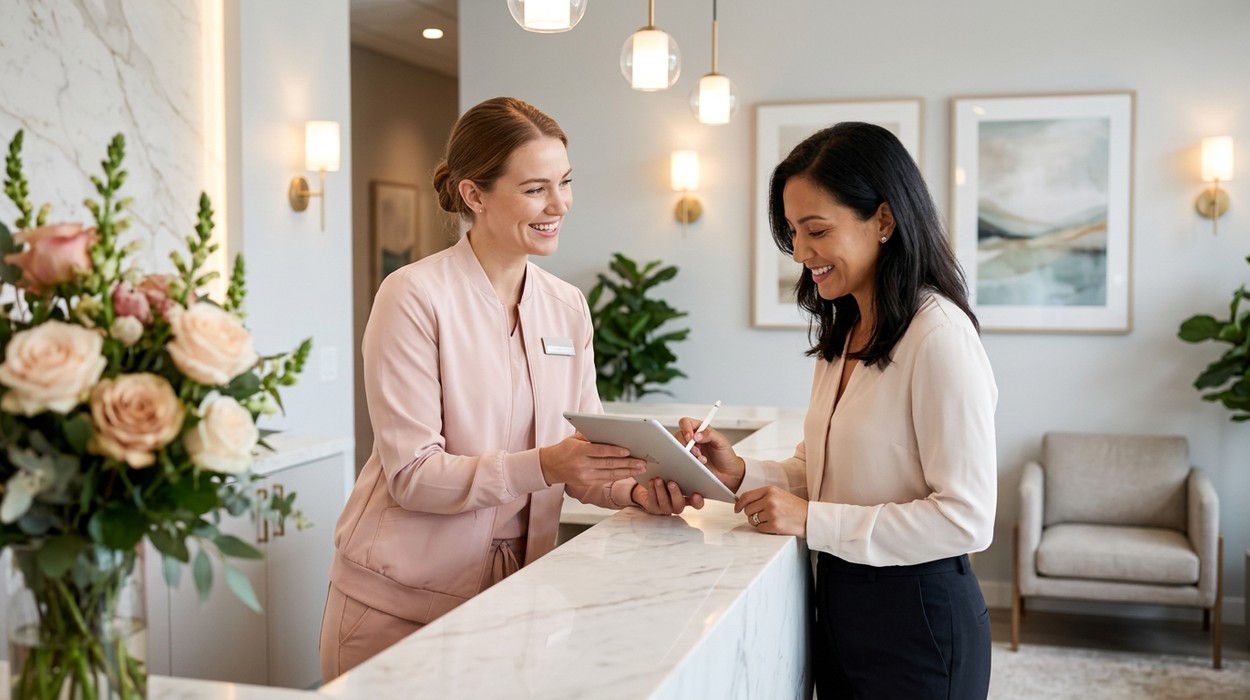

When most medspa owners think about spa management software, they picture a scheduling tool. Something to fill appointment slots and send reminders. That narrow view is exactly why so many practices hit a ceiling they cannot explain.
The right spa management software is not a calendar add-on. It is the operational infrastructure your entire practice runs on — from the moment a new client books online to the moment they leave a five-star review. When that infrastructure is solid, everything else flows. When it is cobbled together from three different apps and a spreadsheet, the cracks show up in the places that cost you the most: missed follow-ups, compliance gaps, staff inefficiency, and clients who simply do not come back.
For example, Sarah opened her medspa with two treatment rooms and a shared Google Calendar. By month six, she had a waitlist. By month nine, she had double-bookings, a stack of paper intake forms she could not locate, and a front desk coordinator who was spending four hours a day just managing communication. The problem was not the volume of business. It was the software that was never built to handle it.
If your practice is growing but the back end still feels chaotic, it is not a staffing problem or a process problem. It is a software problem.
Here is where the misconception lives: most medspa owners evaluate software feature by feature and stop at scheduling. But comprehensive medical spa management software built specifically for medical spas is a stack, not a single tool. It needs to handle every operational layer your practice touches.
Appointment scheduling and online booking are table stakes. What separates medspa-specific platforms from generic booking tools is the ability to assign appointments by provider, service duration, room availability, and equipment — not just open calendar blocks. Your software should also handle deposits, cancellation policies, and waitlists seamlessly.
Client records and intake matter just as much. Paper intake forms are a liability. Medspa management software should include digital intake that clients can complete before they arrive, automatically attached to their record. Every visit, treatment note, photo, and consent form should live in one place, accessible to the provider the moment they walk into the room.
HIPAA-compliant communication is another baseline requirement. Texting a client through your personal phone is not compliant. Your spa management software should include built-in secure messaging, automated appointment reminders, and post-visit follow-up sequences that run without your front desk manually triggering them.
Billing and point of sale need to work inside the same system. Whether you sell packages, memberships, retail products, or single services, your software should process payments, track inventory, apply discounts, and generate reports without requiring a separate platform.
Reporting and business intelligence complete the picture. You cannot grow what you cannot measure. Occupancy rates, revenue per provider, no-show rates, and retention percentages should be available in real time, not reconstructed at the end of the month from disconnected exports.
General practice management tools — the ones built for hair salons, yoga studios, or medical offices — are not built for the operational complexity of a medical spa. The compliance requirements alone set medspas apart. You are dealing with HIPAA-protected health information, informed consent for medical-grade treatments, provider licensing requirements, and in many states, physician oversight documentation.
A generic scheduling tool does not have a consent form workflow. A generic CRM does not know the difference between a provider-administered service and a technician-administered one. A generic point-of-sale system is not thinking about treatment photo documentation or pre- and post-care instructions attached to a service record.
When medspas try to force generic tools into a clinical workflow, they end up with workarounds. Staff develop manual processes to compensate for what the software cannot do. Those processes introduce human error. That human error creates compliance exposure, client dissatisfaction, and operational drag that compounds as the practice grows.
The inflection point comes when the workarounds take longer than the actual work. That is the signal that the software is costing you more than it is saving.
AestheticsPro was built specifically for the aesthetics industry — not adapted from a generic platform and not rebranded salon software. That distinction matters in every feature layer.
The scheduling engine understands provider-based booking, multi-room availability, and service-specific duration rules. Clients book online with real-time availability and receive automated confirmations and reminders without any manual input from your team.
The EMR is built for aesthetic medicine. Treatment notes, before-and-after photo management, provider signatures, and digital consent forms are integrated into each client record. When a provider walks into a treatment room, everything they need is already there. For a deeper look at how the EMR supports clinical workflows, see our full breakdown of what EMR for medical spa teams should actually do.
Client communication runs through HIPAA-compliant channels. Appointment reminders, rebooking nudges, and post-visit follow-ups are automated and trackable. Your front desk stops chasing confirmations and starts managing exceptions.
The reporting suite gives you occupancy, revenue by provider, package redemption rates, and retention metrics in real time. Not at month-end. Right now, whenever you need them.
Everything operates in one platform. No integrations to maintain, no data living in two places, and no reconciling exports at the end of the week.
When medspa owners move from patchwork tools to purpose-built spa management software, the impact shows up in specific, quantifiable ways.
No-show rates drop. Automated reminders with confirmation requests reduce no-shows by an average of 20 to 30 percent without any additional front desk effort.
Admin hours shrink. Digital intake, automated communication, and integrated billing eliminate the manual tasks that consume the most time. Many practices reclaim three to five hours per week per staff member.
Client retention improves. Automated rebooking follow-ups and post-visit check-ins keep clients engaged between visits. Practices that use these tools consistently report measurable increases in return visit rates within 60 to 90 days.
Compliance exposure decreases. When consent forms, treatment documentation, and client records are all stored in one HIPAA-compliant system, the gaps that create liability close.
Provider productivity increases. When providers have instant access to complete client records and pre-completed intake, they spend more time treating and less time asking questions they should already have answers to.
These are not abstract benefits. They are the operational output of software that was designed for what your practice actually does.
You did not open a medspa to manage software problems. You opened it to deliver results for clients, build something that lasts, and create a practice that reflects your standards.
The right spa management software makes that possible. It runs the back end so you can focus on the front. It handles the documentation so your providers can focus on care. It automates the follow-up so no client falls through the cracks after a great visit.
Clients remember how you made them feel. AestheticsPro makes sure you have the time, the tools, and the operational clarity to deliver that experience — every appointment, every provider, every day. Book a demo with an AestheticsPro expert today to learn more.
Related articles on growth, operations, and the systems shaping modern medical aesthetics practices.

Learn how medspa software supports secure documentation, digital consent, and HIPAA compliance to meet medical spa requirements...

Discover holiday upselling strategies to increase revenue in a med spa with packages, med spa loyalty programs, and med spa software...
Explore post-GLP-1 aesthetic treatments for volume loss, skin laxity, body contouring, and how medical spa software supports ongoing care...
Plan for the med spa holiday rush with a practical checklist for staffing, revenue, inventory, communication, and medical aesthetics software...

Learn how to plan winter aesthetic procedures before holiday events, including timing, downtime, skin quality, and natural-looking results...

See when growing med spas need med spa management software, what small business tools may outgrow, and what to look for next...
See what medical spa booking software should do before the visit, from intake and reminders to connected practice workflows...

See how spa management software can support repeat visits, memberships, stronger client retention, and long-term medspa growth...
See how AI-powered med spa software is helping aesthetic practices streamline workflows, save time, and improve the client experience...


 Login
Login