

Growing a med spa is the goal. It is also the moment when everything that worked before starts showing its limits.
The scheduling system that handled one provider starts breaking down with three. The intake workflow that a single front desk staff member managed manually cannot keep up with forty appointments a day. The reporting that gave a rough sense of monthly revenue tells you almost nothing when you need to understand which provider, which service, and which client segment is actually driving growth.
Medical spa management at ten clients a week and medical spa management at a hundred clients a week are fundamentally different disciplines. For many growing practices, that shift is where spa management software becomes less about booking appointments and more about coordinating providers, records, leads, reporting, and client experience in one connected system. The practices that scale without losing control are not the ones that work harder. They are the ones that recognized what had to change operationally before it became a problem.
Adding a second or third provider is the most common growth inflection point in a med spa practice and the one most likely to expose gaps in existing systems. The moment a practice has more than one provider on the floor, scheduling becomes a coordination problem, documentation standards must be consistent across the team, and provider-level accountability becomes a management requirement rather than an assumption.
Who performed which treatment, on which client, on which date, with which product, at which unit count, these are questions a growing practice needs to answer cleanly, both for clinical accuracy and for the audit-readiness that regulatory review and insurance coverage require.
Strong medical spa management at this stage means the systems underneath the practice can answer all of those questions without anyone having to manually reconstruct a record. If the answer to any of those questions requires opening a spreadsheet or calling someone, the infrastructure has not kept pace with the growth.
Esthetician management software helps standardize client records, treatment protocols, and performance visibility across a growing team. That matters because as a med spa expands, the esthetician team often grows alongside the clinical providers and with that expansion comes one of the most underestimated management challenges in the industry: service consistency.
When one skilled esthetician delivers a treatment, the result reflects their individual technique, product knowledge, and client communication style. When three estheticians deliver the same treatment to three different clients, the experience can vary significantly unless the practice has systems in place to standardize it.
Effective esthetician management software gives every team member access to the same client records, documented treatment protocols, and post-visit communication workflows. It also gives practice managers visibility into how each esthetician is performing — rebooking rates, client feedback patterns, service volume — without requiring a manual audit of every interaction.
Consistency is what clients recommend. Inconsistency is what they quietly stop returning for.
A growing practice attracts more leads. That sounds like a straightforward win until the lead volume exceeds the capacity of whatever system, or person, has been handling follow-up.
In practice, the gaps look like this: a consult request sitting in a shared inbox with no one assigned to it, a missed callback after a campaign, an intake link that was never sent because the front desk was managing walk-ins, a rebooking prompt that never went out because no one remembered to schedule it. At low volume these gaps are manageable. At scale they become a conversion problem.
A growing team can increase med spa leads only if the follow-up process is consistent enough to convert interest before it goes cold. That means automated confirmation messages, intake links sent immediately, consultation reminders, and rebooking prompts that go out based on treatment cycle rather than staff memory. Lead management at scale is a workflow problem, not a staffing problem.
Early-stage med spa reporting is usually simple: total revenue, appointment count, maybe a list of services by volume. That level of visibility is enough when the practice is small. It stops being enough the moment the practice has more than one provider, more than one service category, or more than one location.
At the growth stage, reporting needs to answer different questions. Which provider is driving the highest rebooking rate? Which service has the strongest new-to-returning client conversion? Which client segment is generating the most revenue per visit? Where are clients falling off between their first and second appointment?
These questions are not answerable from a simple transaction log. They require a reporting infrastructure connected to scheduling, clinical records, client communication, and payment data simultaneously. When that infrastructure is in place, decisions about staffing, service mix, and marketing become data-informed rather than instinct-driven.
Most med spas start with tools that match their size. A scheduling app, a basic intake form, and maybe a spreadsheet for tracking revenue. Those tools work until they do not, and the moment they stop working is usually not obvious until the practice is already past it.
The clearest signal is when managing the software starts taking more time than the software saves, when staff are manually reconciling records across separate systems, copying client data from one platform to another, chasing down payments that did not sync, or covering gaps with personal effort because the tools were not designed to talk to each other. At that point the operational cost of staying on the current platform has exceeded the cost of switching.
The right spa management software for a growing practice connects scheduling, intake, clinical documentation, communication, loyalty, and reporting in a single system. It grows with the practice rather than requiring a replacement every time a new stage is reached. For practices moving beyond single-provider operations, the right spa software for small business transition point is the one that eliminates coordination gaps without requiring a full enterprise implementation.
AestheticsPro supports growing med spa teams with connected scheduling, provider-level documentation, esthetician workflow management, automated client communication, reporting by provider and service, and loyalty tools — all in one platform built specifically for medical spas.
Book a free demo and see how AestheticsPro helps growing med spa teams manage more without adding more.
Q1: What does medical spa management look like as a practice scales?
Medical spa management at scale means coordinating multiple providers, standardizing clinical and esthetician workflows, managing higher lead volume through connected systems, and using reporting to make decisions by provider and service. The practices that scale well have operational systems in place before growth exposes the gaps in their current setup.
Q2: How does esthetician management software support a growing med spa team?
Esthetician management software gives every team member access to the same client records, treatment documentation, and post-visit communication workflows. It also gives practice managers visibility into individual performance — rebooking rates, service volume, client feedback — without a manual audit. That visibility is what makes consistent client experience possible across a larger team.
Q3: When does spa software for small business stop being enough for a growing med spa?
Spa software for small business stops being sufficient when managing it takes more time than it saves — when staff are manually reconciling records, copying data between systems, or covering operational gaps with personal effort. That is the signal that the tools have not scaled with the practice and the cost of staying has exceeded the cost of moving.
Q4: How does connected spa management software help a growing practice increase med spa leads?
Connected spa management software supports lead conversion by automating the follow-up sequence — confirmation messages, intake links, consultation reminders, and rebooking prompts — so that lead handling does not depend on individual staff memory. The practices that consistently increase med spa leads at scale are the ones whose lead management runs on a system rather than a person.
Related articles on growth, operations, and the systems shaping modern medical aesthetics practices.

Learn how medspa software supports secure documentation, digital consent, and HIPAA compliance to meet medical spa requirements...

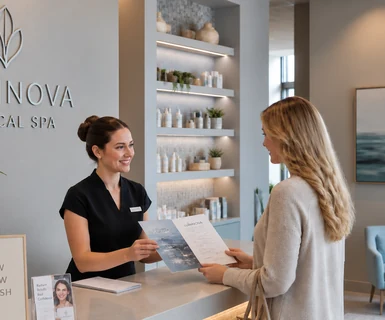
Discover holiday upselling strategies to increase revenue in a med spa with packages, med spa loyalty programs, and med spa software...
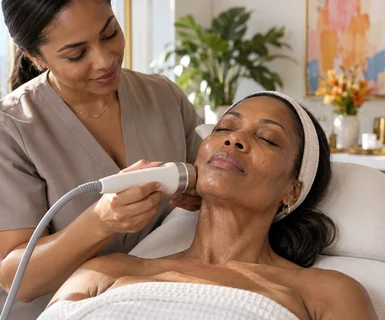
Explore post-GLP-1 aesthetic treatments for volume loss, skin laxity, body contouring, and how medical spa software supports ongoing care...
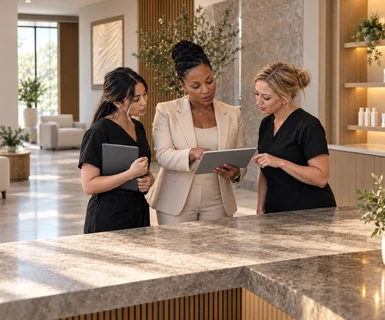
Plan for the med spa holiday rush with a practical checklist for staffing, revenue, inventory, communication, and medical aesthetics software...

Learn how to plan winter aesthetic procedures before holiday events, including timing, downtime, skin quality, and natural-looking results...

See when growing med spas need med spa management software, what small business tools may outgrow, and what to look for next...
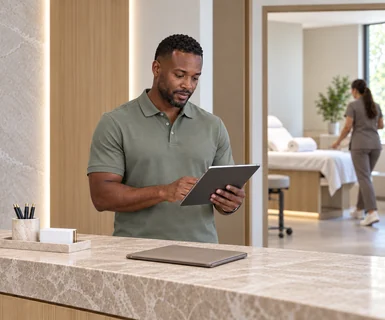
See what medical spa booking software should do before the visit, from intake and reminders to connected practice workflows...

See how spa management software can support repeat visits, memberships, stronger client retention, and long-term medspa growth...
See how AI-powered med spa software is helping aesthetic practices streamline workflows, save time, and improve the client experience...


 Login
Login